
Social media posts and viral news clips have recently claimed that Americans are about to receive new $2,000 direct deposits or federal rebate checks from the IRS. Some versions say the payments are “tariff dividends” announced by President Donald Trump. Others insist that the Treasury has already approved them.
None of these claims are true.
There are no federal “relief” payments, stimulus checks, or direct deposits being sent for the rest of 2025 — and none are scheduled for 2026 either. Here’s a breakdown of what’s really happening, what Trump actually proposed, and why scammers are exploiting these rumors.
- The Origin of the Rumor
- IRS Warning: “Stimulus Check Scams Are Back”
- Trump’s Tariff Rebate Proposal: What Was Actually Said
- Would the Numbers Even Work?
- Legal & Supreme Court Complications
- Proposed Relief Programs Still in Limbo
- What Experts Say About Direct Payments
- Scammers Exploit Economic Anxiety
- The Bigger Picture: Politics and the 2026 Outlook
The Origin of the Rumor
Reports circulating on Facebook, X (formerly Twitter), and TikTok claim the IRS has approved a one-time $2,000 “relief payment” to offset inflation. Some posts even include screenshots of fake Treasury press releases or bank deposit notifications, implying the funds are already on their way.
But neither the IRS nor the U.S. Department of the Treasury has announced any such program. The last official federal stimulus was distributed in 2021 as part of the Recovery Rebate Credit. That program officially expired on April 15, 2025, the final deadline for taxpayers to claim missing stimulus payments.
Roughly one million taxpayers received late checks that year — but that was the end of the pandemic-era Economic Impact Payments.
IRS Warning: “Stimulus Check Scams Are Back”
The IRS has been clear: any messages promising new checks are scams.
In a warning posted on X this summer, the agency stated bluntly, “The Recovery Rebate Credit has expired.” It also reminded Americans that it never initiates contact through text, email, or social media to request banking or personal information — a point frequently emphasized by Tax Relief Attorneys to help clients avoid scams.
Crystal Stranger, senior tax director at Optic Tax in Boulder, Colorado, told Yahoo Finance that even legitimate payments can look suspicious.
“The last stimulus checks were during the pandemic,” Stranger said. “For taxpayers that didn’t have a bank account on file, they were sent out as prepaid debit cards that really did look like a scam.”
Michael Cohn, editor-in-chief of Accounting Today, noted that false tax claims often spike around filing season or times of economic stress.
“Tax-related myths and scams proliferate throughout the year, especially through social media,” he said. “Tax rebates and stimulus checks are a perennial source of speculation.”
The IRS maintains a list of active scams on its website and encourages the public to report suspicious emails or links that ask for banking details.
Trump’s Tariff Rebate Proposal: What Was Actually Said
While no IRS payments exist, there is a related political story driving some of the confusion.
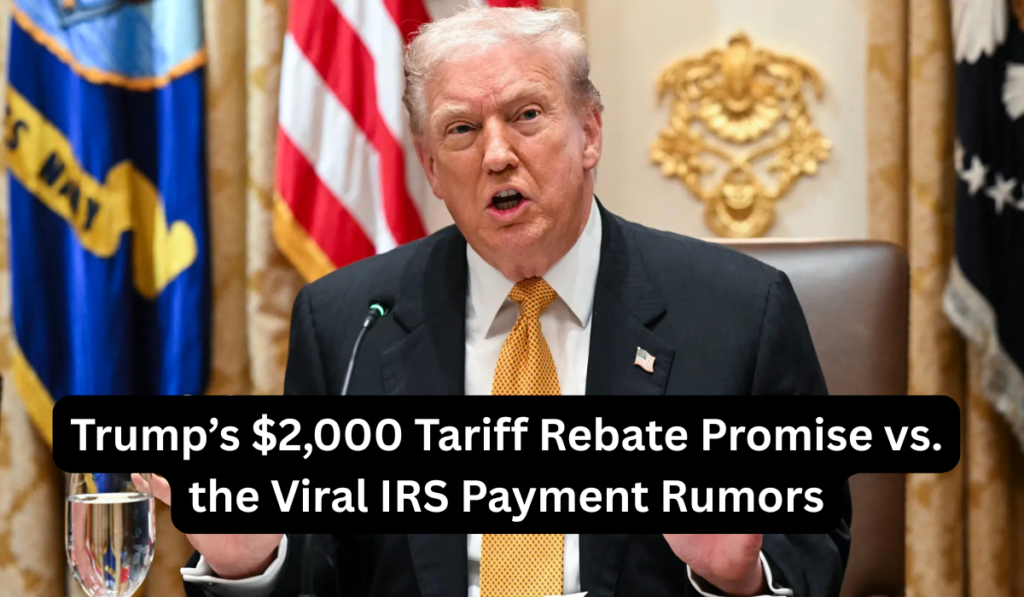
President Donald Trump recently floated the idea of sending Americans “tariff rebate checks” funded by revenue from import tariffs his administration has imposed. He posted on Truth Social:
“People that are against Tariffs are FOOLS! A dividend of at least $2,000 a person (not including high income people!) will be paid to everyone.”
It’s not the first time Trump has mentioned such an idea. He first raised it in August, saying Americans might receive “a dividend” from tariff revenues because the U.S. was “taking in so much money.”
In reality, American importers pay those tariffs upfront, and many pass the costs along to consumers through higher prices. So while tariff revenue enters federal accounts, it indirectly comes from American wallets.
Would the Numbers Even Work?
The math doesn’t support Trump’s promise.
According to the Treasury Department, the U.S. has collected about $220 billion in total tariff revenue under Trump’s policies. Meanwhile, roughly 163 million Americans filed tax returns in 2024. Paying each one $2,000 would cost around $326 billion, far more than the tariff revenue available.
Even excluding high-income earners would not make up the shortfall. Economist Erica York of the Tax Foundation estimates the program would still cost nearly $300 billion — leaving a massive funding gap that any Income Tax Lawyer would recognize as unsustainable under the current tax structure.
And there’s a legal problem: Congress must authorize federal spending. Trump cannot unilaterally issue rebate checks from tariff revenue. Treasury Secretary Scott Bessent acknowledged as much in a November interview, noting that no formal plan or legislation exists.
Legal & Supreme Court Complications
Adding to the uncertainty, about $100 billion of the collected tariff revenue is tied up in Supreme Court litigation over the administration’s use of emergency powers to impose tariffs.
If the Court rules against the administration, the government could be required to refund those tariffs to the businesses that paid them, not redistribute them to individuals. That would wipe out most of the funds Trump has cited as the source of his proposed rebates.
Proposed Relief Programs Still in Limbo
Beyond the tariff idea, several proposed relief efforts are being debated but have not been enacted:
- American Worker Rebate Act (Sen. Josh Hawley): Would send $600 per adult and child, funded by tariffs. The bill remains stuck in the Senate Finance Committee.
- “DOGE Dividend” proposal: A symbolic anti-waste plan from Trump’s campaign, suggesting $5,000 checks from government savings. No actual mechanism or budget exists.
- State-Level Relief: New York issued small refund checks this fall for residents who overpaid state sales taxes due to inflation. Other states — including California, Georgia, and North Dakota — continue offering targeted energy or cost-of-living rebates.
What Experts Say About Direct Payments
Even if Congress approved new checks, economists warn the timing could be risky.
Stephen Kates, a financial analyst at Bankrate, noted that direct cash payments would likely fuel inflation at a moment when the Federal Reserve is trying to keep prices stable.
“Money is money,” Kates said. “When more money comes into the economy to chase the same amount of goods, it’s inflationary.”
Research from the Federal Reserve Bank of St. Louis found that pandemic-era stimulus checks contributed about 2.6 percentage points to inflation in the U.S. economy. As of late 2025, inflation remains above 3%, still higher than the Federal Reserve’s 2% target. Economic experts warn that sending out new stimulus checks could drive prices up again, forcing the central bank to raise interest rates even further. This rise in inflation could also increase financial stress for households and businesses, leading more people to search for solutions such as “Irs Attorney Near Me” when dealing with tax debt, penalties, or delayed payments caused by higher living costs.
Scammers Exploit Economic Anxiety
James Creech, a tax principal at Baker Tilly, said the IRS scam wave is part of a broader trend of fraudsters exploiting public uncertainty.
“In times of inflation or uncertainty, the promise of a quick $1,200 or $2,500 payment can sound too good to ignore,” Creech told Yahoo Finance. “But once you click a fraudulent link and enter your bank information, the scammers have everything they need to take your money instead of sending it to you.”
Creech added, “The IRS will never ask you to enter your bank account information through an unsolicited text, email, or website.”
IRS safety tips:
- The IRS rarely calls taxpayers directly.
- It only uses email or text if you’ve opted in.
- No legitimate government program will charge a “processing fee” to claim funds.
Also Read: IRS is undergoing a massive transformation — AI, paperless systems, and faster digital
The Bigger Picture: Politics and the 2026 Outlook
According to Ed Mills, Washington policy analyst at Raymond James, the debate around rebate checks could intensify as the 2026 midterm elections approach.
“We do not see stimulus checks in the near future,” Mills wrote in a November note, “but we could see greater Congressional interest if consumer spending weakens.”
Still, economists caution that with the national debt nearing $40 trillion, broad rebate programs would be a huge fiscal gamble.
Tomas Philipson, former acting chair of the White House Council of Economic Advisers, summed it up:
“If you pay $2,000 to 100 million Americans, you end up at $200 billion. If you include 200 million, it’s $400 billion. They’d be paying out more than they’ve collected — those numbers just don’t add up.”